A note on funding: CypherpunkGuide carries no surveillance advertising — no ad networks, tracking pixels, or sponsored content. It is funded by transparent streams: reader donations now; subscription and editorially-aligned affiliate later. We answer to our readers, not to advertisers.
Leaving the country is supposed to be the end of the danger. You cross a border, you claim asylum, you start writing under your own name again — and the threat model you carried at home is supposed to expire at the frontier. That is the promise of exile, and it is the assumption most security advice for activists quietly inherits: get out, go dark for a while, and the state you fled loses its reach.
It does not. In 2023, Hong Kong’s national security police issued arrest warrants and HK$1 million bounties for activists living in Boston, London, and Melbourne, under a law that claims authority over things said on the other side of the planet. Belarus once forced a commercial airliner out of international airspace to seize one dissident journalist on board. Freedom House’s 2025 report documented 1,375 incidents of physical transnational repression since 2014, committed by 54 governments across 107 host countries — and that figure deliberately excludes the digital campaigns that usually arrive first, because those are harder to count and even harder to stop.
We read three of these cases the way this series always does — not for the outrage, but for the mechanism. Reading the bounty notices and the court records beside one another, the pattern that emerges is not the one the safety checklists describe. The doxxing is rarely the work of a lone troll with a grudge; it is an opening move in a state operation, it lands differently on women than the gender-blind guides admit, and the part that actually protects you is not a cleverer pseudonym. It is where your work is published from, and when.
The table below is our own synthesis — three reported cases mapped along the axis the doxxing guides skip: not what was leaked, but how the leak was operationalized into reach across a border.
| Case | The doxxing method | How the state operationalized it | The OPSEC lesson it isolates |
|---|---|---|---|
| Belarus — Protasevich, 2021 | Travel itinerary and timing, known in advance | A commercial flight forced down to make a physical arrest | Timing and movement metadata, not identity, is the exposure |
| Hong Kong — HKLeaks & bounties, 2019–2023 | ~2,800 doxxing “cards” of personal data; later, bounties on named exiles | Crowd-sourced harassment escalating to extraterritorial warrants and pressure on relatives | Your social graph and your family are the attack surface |
| China — cross-border network | Identity and location compiled, then shared between states | Interpol abuse, proxy harassment, co-option of host-country contacts | Jurisdiction itself is the variable you can change |
Read across the three, and the controls reorder themselves. None of these people were caught because their pseudonym was weak. They were reached because a state treated a leaked identity as the first step in an operation that crossed a border — and that is a different problem than the one “how to blog anonymously” sets out to solve.
What Doxxing Means Under an Authoritarian State#
Doxxing in an authoritarian context is not online cruelty that ends at humiliation — it is the reconnaissance phase of state repression, the step that converts a critic into a locatable, arrestable, pressurable target. The same act — publishing someone’s real name, address, workplace, and family ties — means something different when the entity acting on the leak is not an anonymous mob but a government with warrants, an intelligence service, or a diplomatic apparatus. The academic literature treats doxxing as a spectrum of intent, from “deanonymizing” to “targeting”; under a hostile state, those collapse into one. The leak is the targeting.
That reframing matters because it changes what you are defending. Against harassment, the goal is to deny strangers your information. Against a state, the information is often already held — what you are denying is operational use of it: the moment when a name on a list becomes a knock on a relative’s door. The International Centre for Counter-Terrorism’s literature review on doxing traces how the tactic migrated from personal vendetta to organized political tool; the cases below are that migration in its finished form.
There is a second reframing the standard guides omit entirely, and it is the one this article exists to make: the threat is not gender-neutral. For women activists, doxxing reliably escalates into sexual threat — rape threats, doctored intimate images, and the weaponization of family and relationships in ways male targets rarely face at the same intensity. That asymmetry is not a footnote; it is a structural feature of how repression is gendered, and it changes the defensive calculus. We give it its own section below, because no competing guide does.
Three Cases: Minsk, Hong Kong, and a Network Without Borders#
The fastest way to see how a leak becomes reach is to lay three documented cases beside one another and trace the same path through each: what was known about the target, how the state acted on it, and what — if anything — the available OPSEC could have changed. These are reported, closed-enough episodes drawn from contemporaneous coverage and primary documents; specifics are attributed to those sources, not reconstructed here.

The mechanism: travel metadata, weaponized in real time. Roman Protasevich, a Belarusian opposition journalist living in exile, boarded Ryanair flight FR4978 from Athens to Vilnius. While the aircraft was over Belarusian airspace, authorities radioed a false bomb threat and scrambled a MiG-29 fighter jet, forcing the plane to land in Minsk. Protasevich and his companion Sofia Sapega were arrested at the gate. The state did not need to find him — it knew his itinerary and acted on it, turning a routine flight into a controlled interception. (GPIL, University of Bonn)
The aftermath corrects a common misreading. Protasevich was sentenced to eight years in May 2023 — and pardoned by Lukashenko nineteen days later, his cooperation extracted and displayed; his actual detention ran closer to two years, not eight (Al Jazeera). Sapega, sentenced separately to six years, was likewise pardoned in 2023 and handed to Russia. The lesson is not the sentence. It is that timing and movement metadata — not the strength of any pseudonym — was the exposure, and that a state will spend an international incident to act on it.
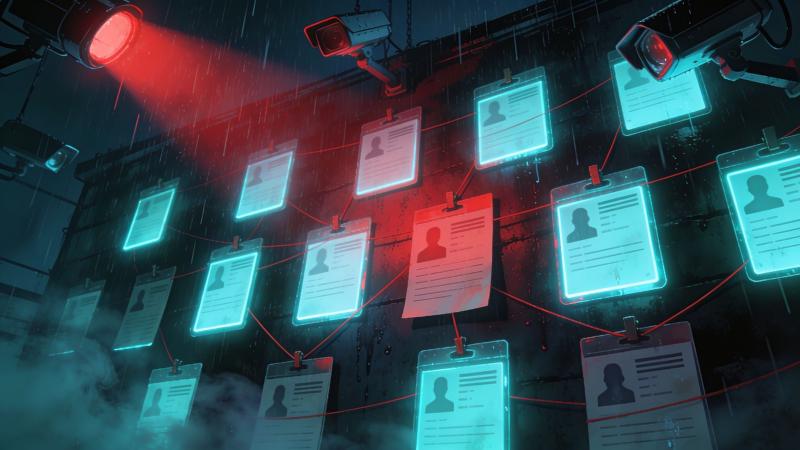
The mechanism: crowd-sourced doxxing escalating into extraterritorial warrants. Beginning in August 2019, the HKLeaks network published “doxxing cards” exposing the personal details of protesters, journalists, and officials — approximately 2,800 individuals, according to Citizen Lab’s forensic study, which found circumstantial evidence that a governmental organization likely conducted or actively supported the campaign rather than attributing it to grassroots actors. The data was the raw material; the National Security Law supplied the reach.
By 2023, that reach had gone fully extraterritorial. Citing Article 38’s claim of jurisdiction over acts committed anywhere, by anyone, Hong Kong police issued arrest warrants and HK$1 million bounties — first for a batch of eight overseas activists in July (Human Rights Watch), then for five more that December, among them Boston-based activist Frances Hui (Hong Kong Free Press). When the named targets could not be reached, the pressure moved to those who could: Hui’s parents in Hong Kong were summoned by national security police, part of a documented escalation against exiled activists’ families (HRW, 2025). The lesson: your social graph and your relatives are the attack surface the moment you personally are out of reach.
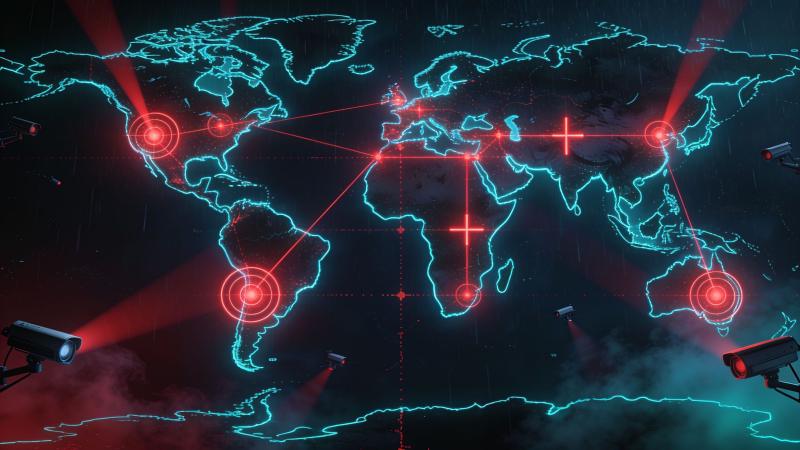
The mechanism: jurisdiction-hopping and proxy enforcement. Where Belarus acted directly and Hong Kong acted through bounties, the broader Chinese apparatus acts through other states’ systems — abusing Interpol red notices, leaning on host-country business and diaspora contacts, and prosecuting agents who pose as community members. In the United States, federal cases have convicted operatives running an undeclared overseas “police station” and a long-term agent who spent years posing as a pro-democracy activist while reporting dissidents to Beijing’s Ministry of State Security (NBC News).
This is the case that isolates the most powerful variable. The reason these operations work is that they exploit the seams between legal systems — the gap an extradition request, a visa record, or a registrar’s compliance desk opens up. Which means the one thing an individual can actually move is jurisdiction itself: where the domain is registered, where the server sits, which platform holds the account. That is the thread the final sections pick up.
Read as a set, the three cases describe an escalation ladder, not three unrelated events. Belarus shows the state acting on metadata it already had. Hong Kong shows the leak (HKLeaks) and the enforcement (bounties, family pressure) as two halves of one operation that crossed borders when the targets did. China shows the mature form: repression routed through the institutions of the very countries that were supposed to offer refuge. At each rung, the identity was never really the secret — the reachability was.
The Gendered Layer: When Doxxing Becomes Sexual Threat#
For women activists, a doxxing campaign rarely stops at exposure — it reliably converts into sexual threat, and that conversion is a deliberate repression tactic, not an unfortunate side effect. This is the dimension the doxxing guides and the OPSEC checklists almost uniformly omit, and omitting it produces defenses calibrated for a threat women do not actually face in the same shape. The exposure is the same; what arrives next is not.
The Hong Kong protests made the pattern visible at scale. Alongside the HKLeaks data, women protesters and journalists faced a parallel campaign of gendered harassment: rape and death threats, and photographs doctored to appear sexually explicit and recirculated to humiliate. Reporting from the period documented images of female protesters altered to read as nude, and named journalists targeted with rape threats while they covered the movement (France 24, 2019). The point of the doctored image is not deception — everyone knows it is fake. The point is to attach a sexual humiliation to your name in every future search, and to signal that your body, not just your argument, is a legitimate target.
The tactic has only industrialized since. In 2025, exiled Hong Kong activists reported a new wave: fake sexualized images of named women on the bounty lists, printed and mailed to their neighbors in the UK and Australia, with one prominent activist’s case under investigation by Thames Valley Police, and a male activist’s wife similarly targeted with sexual posters sent to her address (Reuters, via U.S. News). The escalation is precise: from online image to physical mail, from the target herself to the people around her. It fuses three levers — sexual humiliation, family and community exposure, and the implicit message we know where you live — into a single act.
For threat modeling, this changes two things concretely. First, the “harmless” data is not harmless symmetrically: a face photo, a relationship status, a home neighborhood are raw material for a sexualized attack in a way the generic guides, written for a gender-neutral target, never price in. Second, family and intimate ties are a primary vector, not a secondary one — which is why the defensive sections below treat social-graph isolation and a family communication plan as core controls rather than advanced extras. The synthetic-media dimension of this — how cheaply a convincing fake is now produced — is the same machinery we trace in Your Voice and Face Are Credentials Now, and it lands hardest exactly here.
A Threat Model for Publishing Under Repression#
The defense that survives transnational repression is built on one principle the tool lists invert: moving your infrastructure is more durable than hiding your identity, because jurisdiction is something you can change and a determined state’s ability to deanonymize you eventually is something you cannot. Identity concealment is a delaying tactic — valuable, but degrading over time as a state correlates more data. Infrastructure sovereignty is structural: it determines who can be compelled to act against you, and that is the variable the cases above all turned on. Build the model in layers, matched to the specific reach you are defending against.
Separate the publishing identity from the legal person, early. Before the first post, decide whether you are publishing as a pseudonymous individual, a collective, or a named outlet — because the choice sets your whole liability profile and is painful to change later. A pseudonymous collective diffuses attribution; a named journalist outlet carries publisher liability but can invoke press-freedom protections a lone blogger cannot. There is no universally right answer, only a right answer for your jurisdiction and your tolerance for exposure. What is universal: do not let the operational identity and the legal person share an email, a phone number, a payment method, or a reused handle. The deanonymization machinery that an AI-scale inference engine runs is exactly the correlation of those “harmless” overlaps.
Choose your infrastructure for who can be compelled, not for convenience. This is the layer the mainstream guides reduce to “use a VPN,” and it is far more than that. The domain registrar, the hosting provider, and the distribution channel each represent a compliance desk a state can lean on — so each is a jurisdictional choice, not merely a technical one. Privacy-respecting registrars that do not collect or surrender personal data, hosts located outside the reach of the relevant state, static sites that hold no user database to seize, and decentralized distribution (the Nostr protocol, IPFS, Tor onion services) that no single company can be ordered to delete — these are not paranoia, they are the difference between an outlet that can be removed with one legal letter and one that cannot. The principle is to never concentrate your publishing under a single entity that can be compelled in a single jurisdiction.
| Publishing layer | What a hostile state can compel | The sovereign alternative |
|---|---|---|
| Domain registrar | Registrant identity; suspension of the domain | A privacy-respecting registrar that collects and surrenders no personal data |
| Hosting | Server seizure, access logs, takedown orders | A host outside the adversary’s jurisdiction; a static site that holds no user database to seize |
| Distribution | Account removal, deplatforming, content deletion | Decentralized protocols (Nostr, IPFS, Tor onion services) that no single company can be ordered to erase |
| Publishing timing | Timezone and activity-pattern correlation | Scheduled posting decoupled from your real schedule; protocols whose timestamps do not betray your location |
Treat timing as a fingerprint. Protasevich’s interception turned on movement timing; the same logic applies to publishing. Posting patterns — the hours you are active, the timezone they imply, the rhythm that correlates with one person’s daily life — are metadata that survives even good pseudonymity. Vary them deliberately. Decouple the moment of writing from the moment of publishing through scheduling, and prefer protocols where the published timestamp does not betray your physical timezone. When you publish can deanonymize you as surely as what you publish — and it is the leak almost no one defends.
Plan for the family vector explicitly. Because relatives became the pressure point in Hong Kong the instant the activists themselves were unreachable, a serious threat model includes the people around you: a shared understanding of what is and isn’t safe to discuss, minimized public linkage between your activist identity and your family, and a communication plan that assumes their devices and accounts may be watched. For the practical mechanics of separating identities and auditing what already links you, the audit playbook for a permanent digital footprint is the companion to this section — the doxxer’s raw material is exactly the trail it teaches you to find and prune. Official victim guidance, such as the UK government’s resource on transnational repression, and the practical checklists at Activist Checklist, are worth reading before you need them, not after.
The Limits of Individual Defense#
Here is the honest limit, and a case study that hid it would be repeating the very omission this series was built to correct. OPSEC protects the individual; it does not change the conditions that produced the repression, and against a state willing to spend a fighter jet, a million-dollar bounty, or another country’s legal system, individual technique is necessary and insufficient at once. You can move your infrastructure, vary your timing, and isolate your social graph. You cannot, alone, revoke a foreign government’s claim of extraterritorial jurisdiction, stop it from pressuring relatives still inside its borders, or prevent it from abusing an Interpol notice.
The cases say so when you read them as a set. Protasevich’s tradecraft did not fail — a state simply forced down his plane. The Hong Kong activists’ anonymity was beside the point once the bounties and the family summons began. China’s network works precisely because it operates through institutions an individual cannot opt out of. What actually moves these conditions is the lever cypherpunks have always named where personal cryptography meets institutional power: collective response and changed rules. Host countries that refuse to extradite on political charges and prosecute proxy agents; platforms and registrars that resist compliance with extraterritorial demands; press-freedom organizations and diaspora networks that make a bounty a diplomatic cost rather than a quiet threat. Individual defense buys safety and time. It does not, by itself, close the seams between jurisdictions that repression is built to exploit.
“Privacy is necessary for an open society in the electronic age. … We cannot expect governments, corporations, or other large, faceless organizations to grant us privacy out of their beneficence.” — Eric Hughes, A Cypherpunk’s Manifesto, 1993
The faceless organization here is a state that followed its critic across a border, and the electronic age is the leaked card, the doctored photo, the bounty posted online. Defend the individual case — and then push on the conditions, because no government that issues a transnational bounty will grant you privacy out of its beneficence. The rest of the Sovereignty pillar maps the same fight on its other fronts — the individual set against a power that answers only to pressure.
Bottom Line — Which Protocol Matches Your Risk#
The right level of defense depends entirely on who has reason to follow you across a border, and how far they have already shown they will go.
- If you are a diaspora activist or exile with a named adversary state: assume your identity is known and defend reachability instead. Your front line is infrastructure jurisdiction — registrar, host, and distribution chosen for who cannot be compelled — plus an explicit family communication plan, because relatives are the documented pressure point the moment you are out of reach.
- If you publish investigative or movement journalism from a hostile jurisdiction: decide your liability identity (pseudonymous, collective, or named outlet) before the first post, separate the operational identity from the legal person completely, and treat press-freedom protections as a real but slow, after-the-fact resource — worth invoking, not a real-time shield.
- If you are a woman activist or journalist: price in the gendered escalation from the start. Doxxing is likely to arrive as sexual threat and to route through your family and neighbors, so social-graph isolation and minimizing public face-and-relationship data are core controls for you, not advanced ones.
Across all three, the same truth holds that held in every OPSEC failure before it: once a state treats your leaked identity as the opening move, you cannot un-leak your way back to safety. You can only decide, before you publish, which jurisdiction holds your work and which rhythm reveals your day — and, past the limit of what one person can do, act with others to raise the cost of reaching across a border at all.
Frequently Asked Questions#
How are activists doxxed in authoritarian regimes?#
Through a combination of crowd-sourced or state-supported data leaks and official records. Personal details — name, address, workplace, family, and social-media history — are compiled into public “doxxing” profiles, sometimes by networks that a forensic study like Citizen Lab’s on HKLeaks found were likely state-supported. The leak is then operationalized: used to issue warrants, post bounties, pressure employers or relatives, or, as in the Belarus case, to act on a known travel itinerary. The doxxing is usually the reconnaissance phase of a larger state operation, not an end in itself.
Can a foreign government really arrest me for what I publish abroad?#
It can claim the authority to, and it can act on that claim through other means even where it cannot physically reach you. Hong Kong’s National Security Law asserts jurisdiction over acts committed anywhere by anyone, and in 2023 police issued arrest warrants and HK$1 million bounties for activists living in the US, UK, and Australia. Direct arrest abroad is rare, but extradition requests, Interpol notices, pressure on family still inside the country, and proxy harassment in the host country are all documented. Treat the warrant as real in its effects even if you are not physically extraditable.
Is hiding my identity or moving my infrastructure more important?#
Moving your infrastructure is the more durable defense. Identity concealment is a delaying tactic that degrades as a state correlates more data over time; infrastructure choices — which registrar, host, and distribution channel hold your work — determine who can be legally compelled to act against you, and that is the variable the major cases all turned on. Do both, but if you must prioritize, choose every layer of your publishing stack for which jurisdiction it sits in and who cannot be ordered to remove it.
Why does doxxing target women activists differently?#
Because for women, exposure reliably escalates into sexual threat as a deliberate tactic — from doctored explicit images in the 2019 Hong Kong campaigns to fake sexualized images mailed to exiled women’s neighbors in 2025. As the gendered-layer section above details, this makes face photos, relationship data, and home-neighborhood information higher-risk for women, and social-graph and family isolation core controls rather than advanced ones.
What should I do first if I think I am being targeted?#
Document everything with dated records stored on a personal device, and contact a press-freedom or human-rights organization and your local police rather than handling it alone — official guidance, such as the UK government’s resource on transnational repression, exists for exactly this. In parallel, audit what publicly links your activist identity to your legal person and your family, and reduce that linkage. Assume relatives’ devices and accounts may be watched, and agree with them on what is safe to discuss. Reactive cleanup is harder than prevention, but a documented timeline is what any later legal or advocacy response will need.
| # | Source | URL | Archive |
|---|---|---|---|
| 1 | Human Rights Watch — Hong Kong Warrants Aim at Activists Abroad (Jul 2023) | https://www.hrw.org/news/2023/07/04/hong-kong-warrants-aim-activists-abroad | https://web.archive.org/web/*/https://www.hrw.org/news/2023/07/04/hong-kong-warrants-aim-activists-abroad |
| 2 | Hong Kong Free Press — Arrest warrants & HK$1M bounties for 5 overseas activists (Dec 2023) | https://hongkongfp.com/2023/12/14/breaking-hong-kong-national-security-police-issue-arrest-warrants-hk1-million-bounties-for-5-overseas-activists/ | https://web.archive.org/web/*/https://hongkongfp.com/2023/12/14/breaking-hong-kong-national-security-police-issue-arrest-warrants-hk1-million-bounties-for-5-overseas-activists/ |
| 3 | Citizen Lab — HKLeaks: covert and overt online harassment tactics (Jul 2023) | https://citizenlab.ca/research/hkleaks-covert-and-overt-online-harassment-tactics-to-repress-the-2019-hong-kong-protests/ | https://web.archive.org/web/*/https://citizenlab.ca/research/hkleaks-covert-and-overt-online-harassment-tactics-to-repress-the-2019-hong-kong-protests/ |
| 4 | Human Rights Watch — Hong Kong: Targeting of Exiled Activists’ Families Escalates (May 2025) | https://www.hrw.org/news/2025/05/04/hong-kong-targeting-exiled-activists-families-escalates/ | https://web.archive.org/web/*/https://www.hrw.org/news/2025/05/04/hong-kong-targeting-exiled-activists-families-escalates/ |
| 5 | Al Jazeera — Belarusian activist Protasevich pardoned (May 2023) | https://www.aljazeera.com/news/2023/5/22/belarusian-activist-pardoned-by-minsk | https://web.archive.org/web/*/https://www.aljazeera.com/news/2023/5/22/belarusian-activist-pardoned-by-minsk |
| 6 | GPIL, University of Bonn — Banning Belarusian airlines after the FR4978 diversion | https://gpil.jura.uni-bonn.de/2023/10/banning-belarusian-airlines-in-response-to-belarus-diversion-of-ryanair-flight-fr4978-as-a-third-party-countermeasure/ | https://web.archive.org/web/*/https://gpil.jura.uni-bonn.de/2023/10/banning-belarusian-airlines-in-response-to-belarus-diversion-of-ryanair-flight-fr4978-as-a-third-party-countermeasure/ |
| 7 | Freedom House — Transnational Repression (1,375 cases; 54 origin / 107 host countries) | https://freedomhouse.org/report/transnational-repression | https://web.archive.org/web/*/https://freedomhouse.org/report/transnational-repression |
| 8 | France 24 — HK women protesters facing rape threats and doctored images (Sep 2019) | https://www.france24.com/en/20190902-attacked-for-gender-not-views-hk-women-protesters-facing-troll-army | https://web.archive.org/web/*/https://www.france24.com/en/20190902-attacked-for-gender-not-views-hk-women-protesters-facing-troll-army |
| 9 | Reuters (via U.S. News) — Exiled HK activists targeted by fake sexualized images (Dec 2025) | https://www.usnews.com/news/world/articles/2025-12-12/exiled-hong-kong-democracy-activists-say-theyre-targeted-by-fake-sexualised-images | https://web.archive.org/web/*/https://www.usnews.com/news/world/articles/2025-12-12/exiled-hong-kong-democracy-activists-say-theyre-targeted-by-fake-sexualised-images |
| 10 | UK Government — What to do if you are a victim of transnational repression | https://www.gov.uk/government/publications/transnational-repression/what-to-do-if-you-think-you-are-the-victim-of-transnational-repression | https://web.archive.org/web/*/https://www.gov.uk/government/publications/transnational-repression/what-to-do-if-you-think-you-are-the-victim-of-transnational-repression |
| 11 | ICCT — Doxing: A Literature Review (Dec 2024) | https://icct.nl/publication/doxing-literature-review | https://web.archive.org/web/*/https://icct.nl/publication/doxing-literature-review |
| 12 | NBC News — Chinese agent case in New York, a classic Beijing spy effort | https://www.nbcnews.com/investigations/chinese-agent-case-new-york-classic-beijing-spy-effort-experts-say-rcna169506 | https://web.archive.org/web/*/https://www.nbcnews.com/investigations/chinese-agent-case-new-york-classic-beijing-spy-effort-experts-say-rcna169506 |